

Change Embodiment™ Methodology
Most change initiatives are declared successful. Many don't actually work. But it is not just the big ones. The same gap shows up in every team, process, and strategy that should be working differently and is not. We make sure yours does.
The Uncomfortable Truth
Bain surveyed more than 400 executives and senior leaders in 2024 and found that only about 12% of business transformations achieve their original ambition. The strongest predictor of the ones that work is not method or governance. It is whether the organization has the capacity to carry it, and the most common failure is loading the change onto people who are already full.
That is a capacity finding, not a change management finding. And capacity is the thing traditional change management never checks.
It tracks adoption when the question is embodiment. It declares victory at go-live when value takes six to twelve months to show up.
That canyon shows up every time something needs to be working differently and it is not.
Adoption asks: "Are people using it?"
Embodiment asks: "Is this how they naturally work now?"
There's a canyon between those two questions. Most organizations fall right into it.
And it is not just the enterprise transformations.
That canyon shows up every time something should be working differently and it is not. The sales team that agreed to a new methodology but reverts under pressure. The HR process that was redesigned but still frustrates everyone. The strategy the leadership team endorsed that has not changed a single decision.
Same gap. Same cost. Same question: was it embedded, or was it embodied?
Change Embodiment™ delivers everything traditional change management delivers: Communications, training, sponsorship, coaching, adoption tracking, reinforcement. All of it.
Then we add what's been missing: the frameworks, tracking, and validation that ensure change doesn't just get implemented, it gets embodied.

Embedded vs. Embodied™
Embedded means it's been installed. The system is live. The training is done. The process is documented. From an organizational standpoint, the change exists.
Embodied means it's being lived. People follow the process because it's how they are naturally working now. The change isn't just present. It's absorbed.
Every organization has a gap between these two. So does every team, every leader, and every strategy that was agreed to but never lived. Traditional change management focuses on embedding.
We focus on what happens after: the harder, slower, more human work of helping people actually internalize the change until it becomes simply how they work.
Gartner surveyed 2,900 employees in April 2025. 79% have low trust in their organization's ability to change effectively. Most believe their organization made poor change decisions before, and expect the same again.
Source: Gartner, April 2025, published in HBR, January 2026

Traditional change management assesses readiness for a specific change. We track capacity: whether people can absorb ANY change right now.
MIA™ tracks three things:
Motivation: Do people see the purpose? Do they have the energy to engage? When motivation drops, you see cynicism and "this too shall pass" attitudes.
Intention: Do people have clarity on what's expected? When intention drops, you see confusion, conflicting priorities, and effort spent on the wrong things.
Attention: Do people have the bandwidth? When attention drops, you see overwhelm, training that doesn't stick, and change fatigue setting in.
When MIA™ is healthy, people can embody change. When it drops, they go through the motions at best. Gartner surveyed 473 HR leaders in July 2024. 73% reported that their employees are fatigued from change. The people closest to the workforce can already see it.
We diagnose MIA™ before, during, and after. Because you can't ask people to absorb more if you don't know what they're already carrying.
10 enterprise changes per employee in 2022. Two in 2016.
Five times the load, and nobody is tracking whether people can carry it. Source: Gartner
Six Dimensions. One Goal: Change That Lasts.
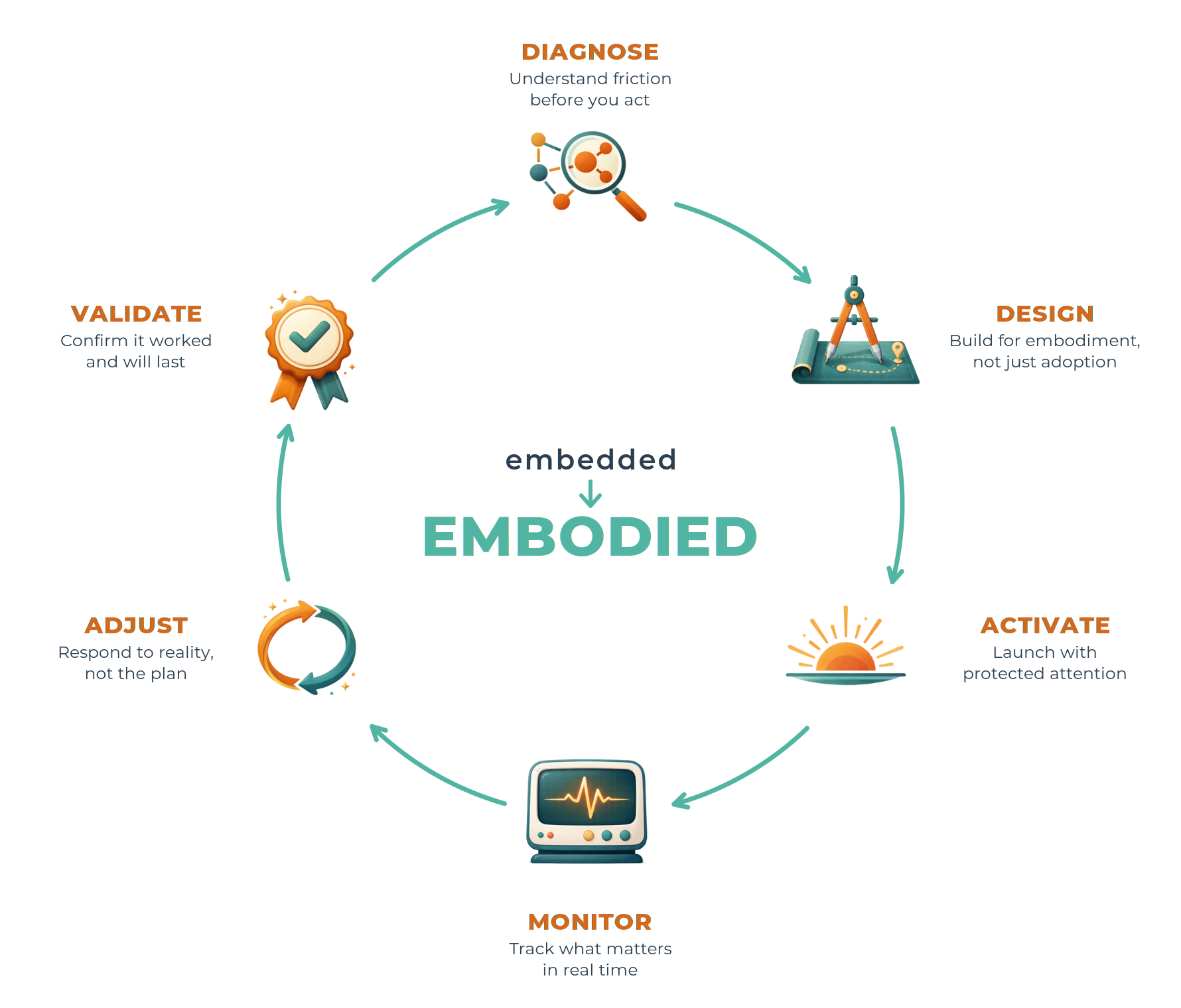
Change Embodiment™ works across six dimensions, each one addressing a gap that traditional change management ignores. We start by diagnosing where friction actually lives before designing solutions. We activate with attention to human capacity, monitor what matters in real time, and adjust based on evidence, not assumptions. And we don't walk away when the rollout is done or the decision is made.
We validate that the change is fully embodied, that it delivered the intended value, and that your organization is stronger.
Beyond Adoption: Change That Actually Works
Validating Return on Intention™, Not Just ROI
Traditional Change Management
Communication Plan
Training Plan
Stakeholder Engagement
Sponsor Plan
Coaching Framework
Reinforcement Plan
Change Embodiment™
Two-Way Conversation Architecture with MIA™ Pulse Feedback
Capability & Proficiency Roadmap with Role-Based Success Clarity
Influence & Advocacy Mapping with Trust Assessment
Sponsor Activation & Executive Alignment with Momentum Decision
Manager Enablement System with Intervention Triggers
Continuous Validation with Embodiment Dashboard
Embedded vs. Embodied™ | 3P Friction Diagnosis
Traditional change management focuses on whether the change happened. We focus on whether it worked, lasted, and at what human cost.
This isn't about throwing out what exists. It's about adding what's been missing.
Leadership Development Is Change Too
When we ask leaders to shift how they communicate, delegate, or develop their teams, we are asking them to embody something new. Leadership Embodiment™ applies this same methodology to leaders at every level.
Explore Leadership Embodiment™ →
What Change Embodiment™ Delivers
When you track what actually matters, protect human capacity throughout, and validate outcomes after the change is made, you get something different.
Not just a change that was announced. Not just boxes that got checked. You get change that people own, results you can prove, and an organization with capacity left for what comes next.

EMBRACED

Not resisted
PROVEN
Not Assumed

STRONGER
Not Depleted
Among employees with above-average change fatigue, only 43% intend to stay. Among those with low fatigue, 74% do. Same organization, same job, thirty-one points apart. Source: Gartner
Want the full picture?
Our white paper breaks down why traditional change management tracks the wrong things, and how Change Embodiment™closes the gap. Includes the research, the frameworks, and the case for validating what actually matters.
Advisory Board
Engage3P Change Embodiment™ is guided by experts in behavioral science, organizational psychology, and transformation leadership.

National behavioral health leader whose purpose and passion is to identify solutions to wicked problems within the country's human and health systems by harnessing the knowledge, expertise and innovations of teams and communities.
Dr. Drennen is the Branch Chief for Disaster Behavioral Health and Community Recovery with 30 years of experience in clinical psychology, emergency management, and disaster behavioral health. He holds a PsyD in Clinical Psychology.
Operations and Response Branch Chief, State of ColoradoCurt Drennen, PsyD, RN

Catarina R. Dolsten, MD, MA is the founder and CEO at Aktum Group. Dr. Dolsten works with executives and CHROs to transform organizations.
Catarina brings extensive experience from executive and management settings in the United States, Europe and Africa. Catarina received a masters from Columbia University in Organizational Psychology, she is a Certified Coach from NYU and a Medical Doctor from Lund University, Sweden.
Catarina R. Dolsten, MD, MA
Founder & CEO, Aktum GroupReady for Change That Actually Works?
The Clarity Diagnostic assesses friction across People, Process, and Platform, establishes your MIA™ baseline, and identifies the gaps between what's embedded and what's embodied. Weeks to clarity before you commit resources.
Start with the Clarity Pulse Check.
It reveals your Motivation, Intention, and Attention in minutes and shows whether your people have the capacity for what's coming next.