AI EMBODIMENT™
The largest prescribe-before-diagnose event in enterprise history.
Companies are buying AI at a speed no transformation has ever experienced, into workforces nobody has assessed, for outcomes nobody has defined.
Embedding AI is the easy part. Embodying AI, making it how your people actually work and thrive, is the whole goal.

Not embodied AI in the robotics sense. This is about whether AI becomes how your people actually work.
THE PART NOBODY MEASURES
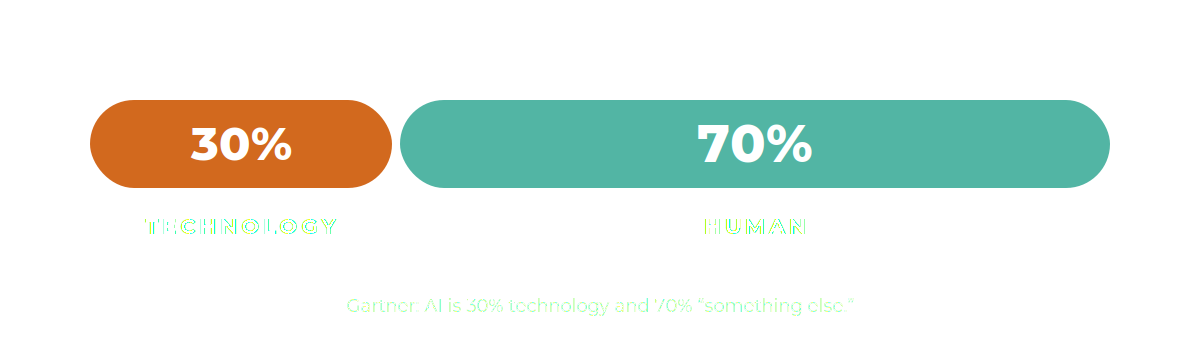
BCG puts the split at 10 percent algorithms, 20 percent technology and data, and 70 percent people and processes. Every serious analysis of AI failure lands in the same place: the constraint is human, not technical. The market still sells the tool, the training, and the prompt library, then reports how many seats logged in. None of that tells you whether the work changed.
That gap is the whole reason this exists. We diagnose the one thing the rest of the field leaves unexamined: whether your people can carry AI, and whether they actually did.
The instrument is MIA™.
It is the line between a company that installed AI and one that lives it.
And this is not a practice spun up last quarter to ride the wave. AI Embodiment™ is Change Embodiment™ pointed at AI. The AI is new. The discipline underneath it is not.

Why the old playbook does not fit
Change management assumes a known destination. Define the future state, plan the path, move people along it. Every part of that assumption breaks here.
01
The destination keeps moving.
The capability in June is not the capability in December, so a future state defined at kickoff describes something that no longer exists by the time the training is built.
02
Nobody can specify correct use.
Training works by transferring a right answer that already exists. AI has no right answer waiting to be transferred. The value depends on the judgment of the person holding the tool, on a task nobody specified, at a moment nobody predicted.
Train-and-rollout does not underperform here. It has nothing to deliver.
03
The guardrails did not come in the box.
Every other enterprise system arrived with permissions, audit trails, and a compliance posture. AI arrived with none, and organizations are writing policy from scratch, usually before anyone has watched how the work is really being done.
04
The workforce arrived before the strategy did.
People walked in already fluent, already using tools on personal accounts, already expecting more than their employer has sanctioned. The usual sequence, where the organization introduces the capability and the workforce catches up, ran backwards.
05
And there is no settling point.
Every prior rollout ended. Go-live, stabilize, absorb, move on. AI has no stabilize phase, because continuous change is the product, not a phase of the project.

Underneath all five sit two costs nobody budgeted.
The first surfaces in exit interviews. People were told this would make the job better. The distance between that promise and what actually changed is where the disillusionment lives, and it is expensive: in the people who stop trying, in the ones who quietly go back to the old way, and in the ones who leave.
The second has no name yet. Every AI redesign removes something, and the removed thing is rarely the thing anyone meant to remove. When the summary lands in every inbox, nobody calls a colleague afterward to ask what happened, and the follow-up conversation carried half the value. When a junior analyst receives the answer instead of building it, the answer arrives and the judgment does not. None of this appears in a business case, because nobody counted it before it was gone.

Every AI program can point to something real. A signed enterprise agreement, a launched pilot, a completed prompt-writing session, a license on every desk. All of it reportable. None of it proof that anything changed.
Embodied is the analyst who now opens a draft differently, the manager who changed how a decision gets made, the team that stopped doing a weekly task nobody has done manually in four months.
Most organizations are measuring the first and reporting it as the second.
THE SIX DIMENSIONS
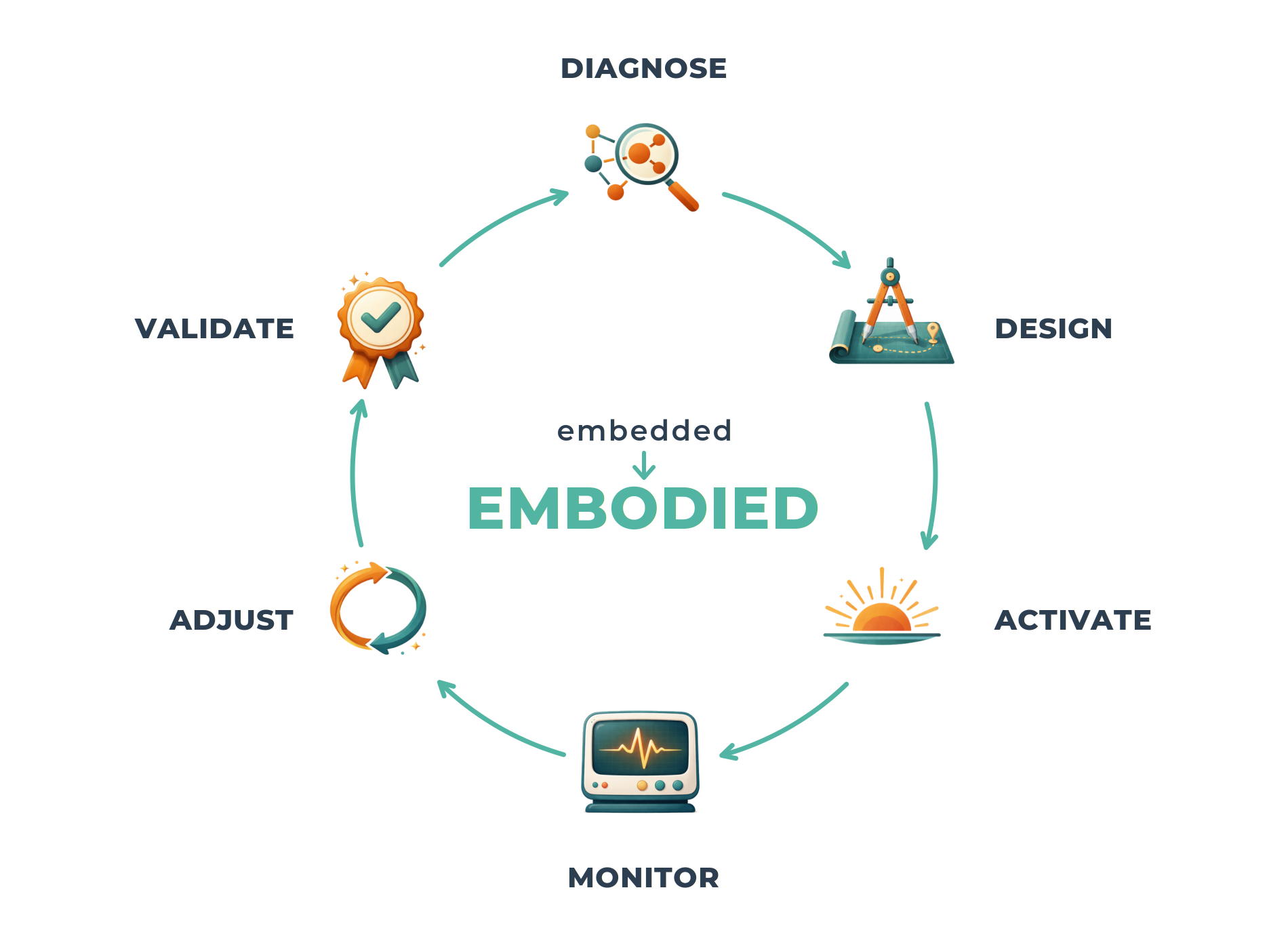
The six dimensions come from Change Embodiment™.
With AI, they stop running once and start running as a loop, because the technology never settles.
DIAGNOSE
They already started. Find out where.
Most AI programs open with a vendor decision. By then the real question has already been answered somewhere else, on personal accounts, in browser tabs nobody sanctioned, by people who started before anyone asked them to. Diagnosis starts there: what people are already doing, what they are hiding, where the friction sits, and which problem is worth solving first. Then the harder read. MIA™ surfaces whether the organization has the capacity to absorb anything at all right now. The technology arrives finished. The organization never does.
DESIGN
Guardrails that widen, not a policy nobody follows.
AI shipped without guardrails, so every organization builds its own. Most build them first, in a policy document written by people who have never watched the work happen. A rule written in advance is a guess about uses that have not happened yet. Design means governance and people arriving together: where AI genuinely helps, what people are free to try, and how the rules widen as the work does. Built this way, guardrails stop working as a brake and start working as permission.
ACTIVATE
One real problem, one willing team.
Start with one real problem and a team that wants it solved. Then weave AI into the work itself, until using it stops being a separate step. Adoption that lives beside the work fades the moment the champion looks away. And watch what the redesign removes, so the removal is decided deliberately, not by default.
MONITOR
The dashboard cannot see this.
Dashboards count logins, prompts, seats. With an ERP, usage is adoption, because there is one correct way to work the system. With AI, a person uses it forty times a day and produces nothing that matters, or twice and changes a decision. Usage and value came apart, and no dashboard can tell the difference. MIA™ reads what the dashboard cannot see. When MIA™ drops, people go MIA.
ADJUST
No end state, so no final plan.
Every other transformation has a finish line. AI does not. The models change under the rollout, and a plan signed in March describes a world that is gone before the rollout finishes. So the work stays live: widen what is working, rebuild capacity where it dips, revisit the plan on a schedule instead of on a crisis.
VALIDATE
Did the work change, or just the tooling?
Companies declare victory on go-live day. AI does not have one, so most organizations never ask the question. Validation runs on a cycle, and it re-anchors to the intention in force now rather than the one written at the start. Embedded is installed. Embodied is lived. Return on Intention™ proves which one happened.
Sound familiar?
None of these shows up on a dashboard. If one sounds like your company, that is exactly the point.
A rollout is six months old and the usage numbers look fine, but no process has changed and nobody can name what moved faster.
Policy went out before anyone studied the work, and the people doing the work now route around it quietly.
Two integrations are running at once, a reorg is underway, and AI is landing on a workforce that has not absorbed the last thing.
Leadership announced something ambitious, publicly, and the distance between the announcement and the daily reality is now visible to everyone inside.
An acquisition closed and both sides brought different AI habits, one sanctioned, one not, and nobody has looked at either.
If any of these is you, that is where a Clarity Call starts.
HOW IT STARTS
It starts with a conversation and a diagnostic, not a commitment.
We read where your people actually are, where the friction sits, and which one problem is worth solving first.
From there, the smartest first step for most teams is a small, contained beta: one team, one real problem, one tool. Low risk, real evidence, a case study you can act on. Scale across the organization when the evidence earns it. If a beta is not the right entry for you, the same method runs at whatever scope fits.
Whatever the scope, the work runs in three moves.

01
CLARITY
Diagnose before you invest. What people are already doing, where the capacity is, and the one problem worth solving first.
02
STRATEGY
Design for a target that keeps moving. Governance and people built together, and the sequence of what moves first.

03
MOMENTUM
We stay through execution, and we build the organization's ability to run the cycle itself: read MIA™, widen what works, and validate against the intention in force now. Ongoing support after that is a choice, made when the evidence says it is worth it.

Independent by design means no vendor position and no product to sell. The technical build, the platform and the tooling, is a partner's lane, brought in when the work needs one. Ours is the human side: whether people absorb what is chosen, and whether the work actually changes. Every recommendation traces back to what the organization needs, and nothing else.
It does not mean handing over a report and leaving, and it does not mean staying for the sake of staying.
THE INSTRUMENT
MIA™ measures Motivation, Intention, and Attention: whether people see the purpose, know what is expected, and have the capacity to absorb anything at all right now. It reads capacity, not enthusiasm for one initiative.
In a normal change, that read covers the group going through it and then the engagement ends. AI has no such boundary. The moment it works, it spreads from the first team to every user and never stops changing, so MIA™ has to run across the whole workforce, continuously, because the change never ends. We build that read into how the organization operates, so it keeps running whether we are in the room or not.