
Why is human due diligence critical in a merger or acquisition?
Human due diligence reads whether the people a deal depends on have the capacity and the commitment to carry the plan. Financial diligence prices what people cost. Human due diligence reads whether they will stay, keep the clients, and work the new way, and it starts before the money moves.
Every deal team keeps two lists. The first gets priced line by line: salaries, benefits, retention for the names the deal can’t lose, and a synergy schedule with dates on it. The second rarely makes it into the data room: whether the people holding the client relationships still believe, whether the team told to sell something new knows how, and whether the habits that made the business work survive the move. The first list says what the people cost. The second decides whether the thesis holds.
The people who matter most are rarely the ones on the list
Diligence tends to stop at the top. Deal teams focus on the partners, the senior leaders, and the names on the retention schedule, and that is where the golden handcuffs go. But the value in a business is rarely held only by the people with the biggest titles. It sits with the manager a key client actually calls, the team that has quietly carried a critical process for a decade, and the person who knows why the system works the way it does and never wrote it down.
No deal can put golden handcuffs on everyone, and no deal team can protect what it never found. Human due diligence reads the whole organization, group by group, so the people carrying the value show up before close instead of after they leave.
What human due diligence reads
At its center is MIA™, which is capacity: whether people can take on what the deal is about to ask of them. It has three parts.
Motivation: do people see the purpose, and do they have the energy to engage?
Intention: are they clear on what is expected of them?
Attention: do they have the room to do it?
When MIA™ drops, people go MIA. It is read group by group, never as one company average, because an average hides the group a deal depends on most.
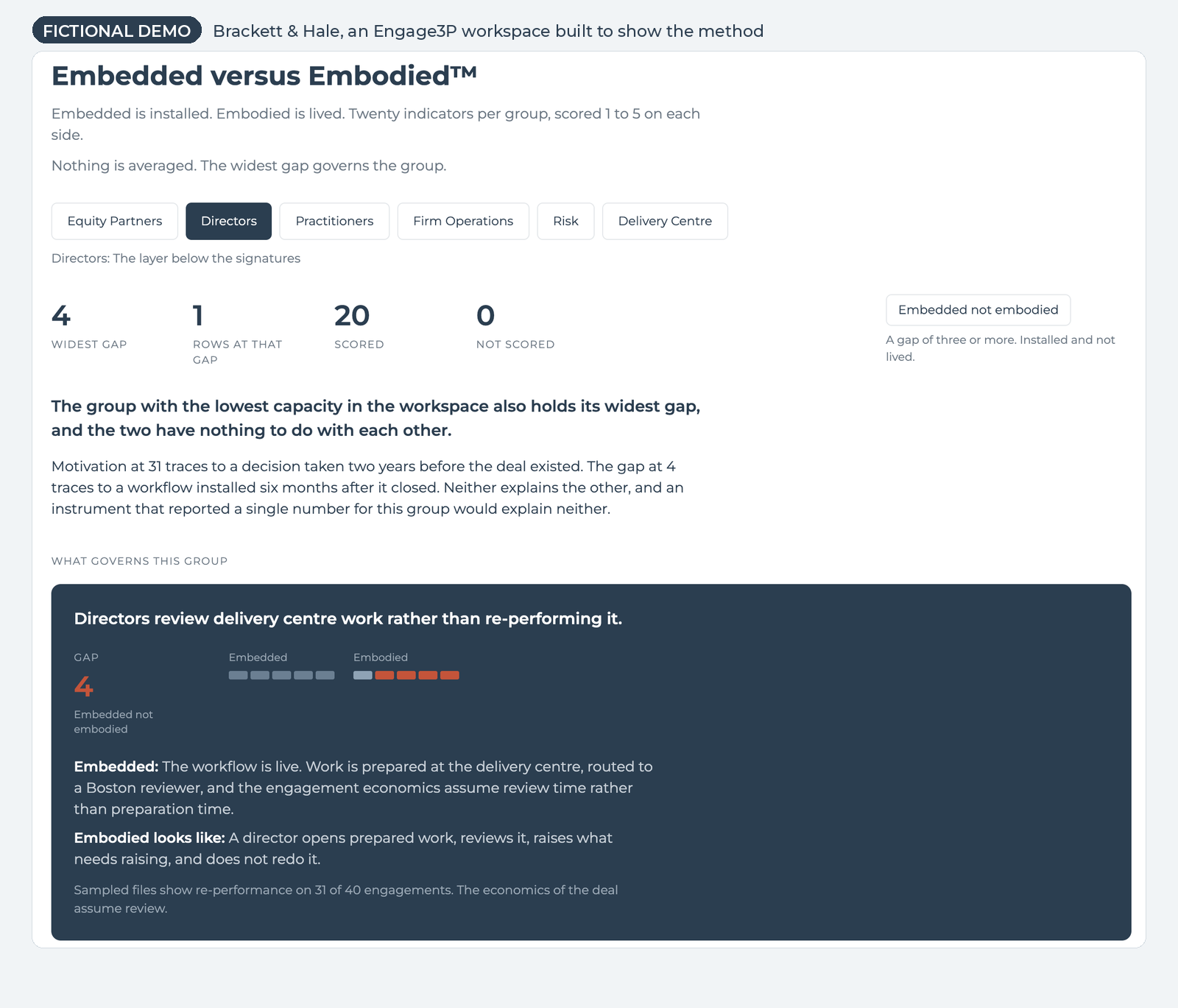
Alongside capacity, human due diligence reads who holds the revenue day to day, and the gap between what the change installs and how people actually work, which Engage3P calls Embedded vs. Embodied™.
It is not one and done. The first read is part of diligence, before signing. After close, it is pulsed through integration, so leaders can see where people sit as the plan meets reality. On a platform, it continues with every add-on, because each new acquisition layers more change onto the people already there.
A working example: Brackett & Hale
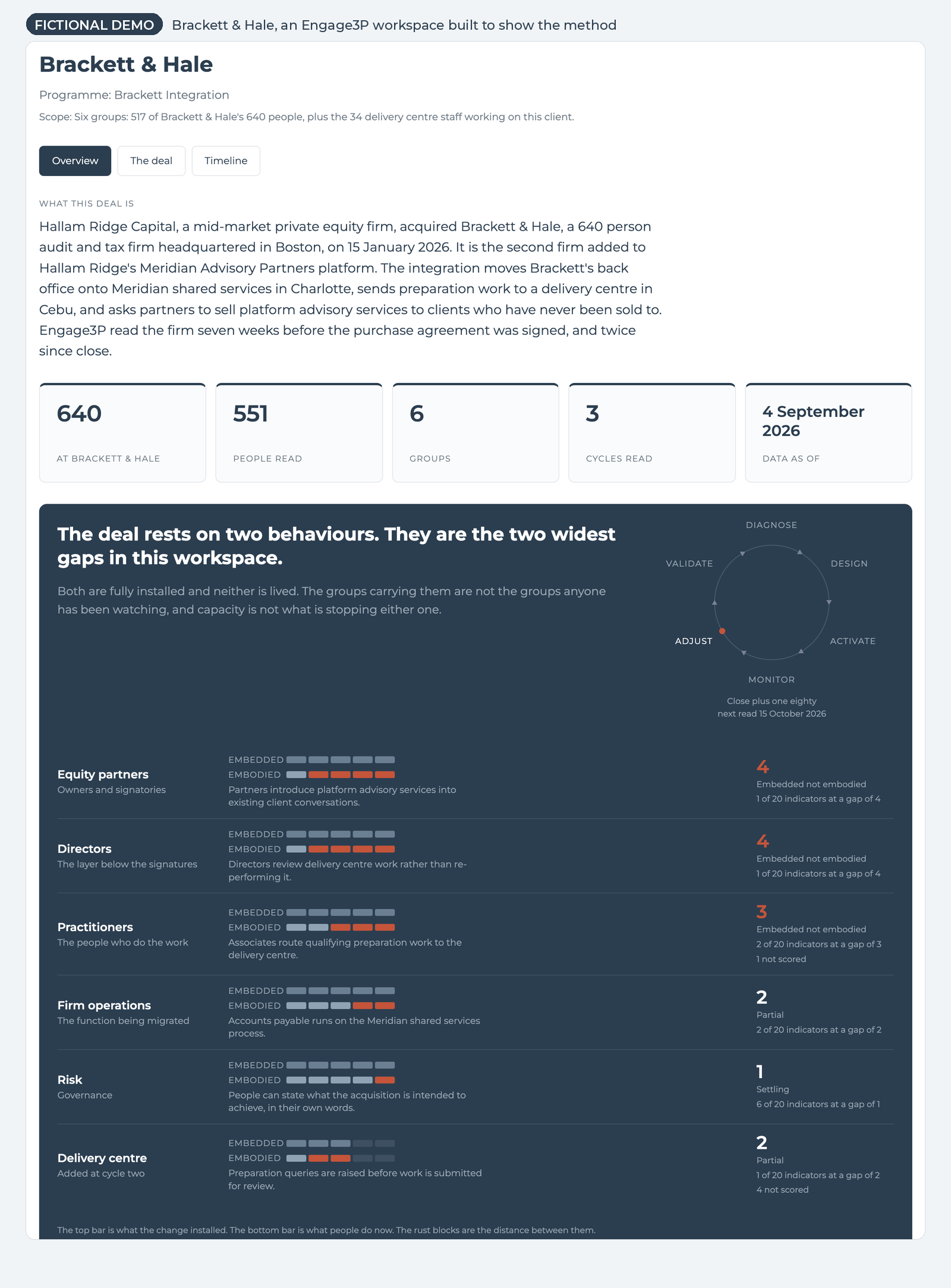
Brackett & Hale is a constructed deal. The firm, the people, and every number are fictional, built to show the method end to end inside a working Engage3P workspace.
In the story, Hallam Ridge Capital, a mid-market private equity firm, acquires Brackett & Hale, a 640-person audit and tax firm in Boston. The investment thesis fits in one sentence: acquire a Northeast audit base, migrate the back office onto shared services for margin, and sell advisory services into a client base that has never been sold to. Every part of that sentence depends on people doing something differently.
What the read found before signing
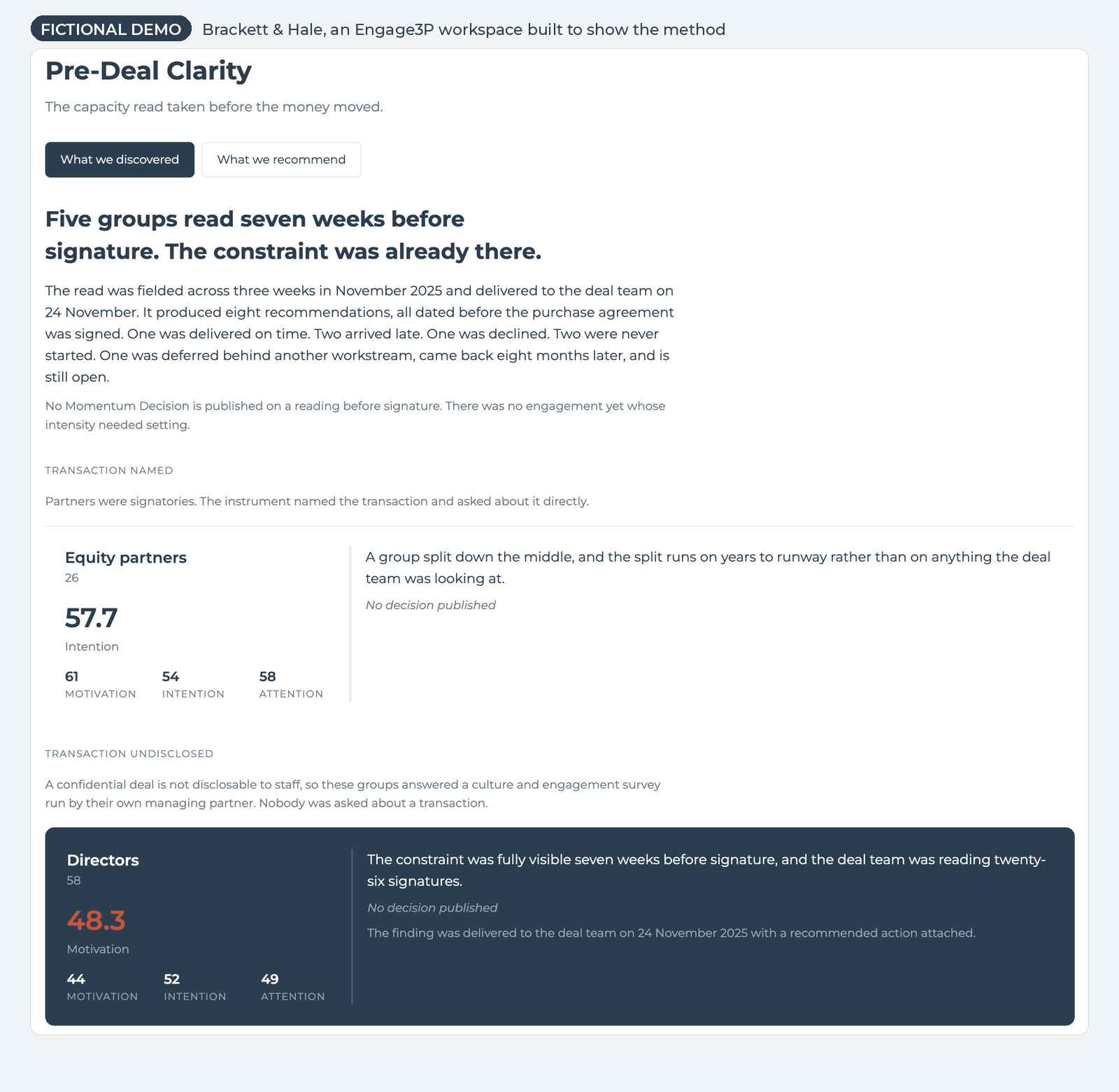
The first read ran seven weeks before the purchase agreement was signed. The equity partners were signatories, so they saw the transaction named. Everyone else answered a culture and engagement read commissioned by their own managing partner. Nobody was asked about a deal and nobody was deceived. Confidentiality held, and the read still worked.
The deal team was focused on 26 equity partners. The constraint sat one layer below them, with the 58 directors. They had the lowest capacity in the firm, and the cause was two years old: partnership admissions had been quietly stopped in late 2023 while the firm explored a sale. The stop was never announced as a stop. Directors kept hearing “next year.”
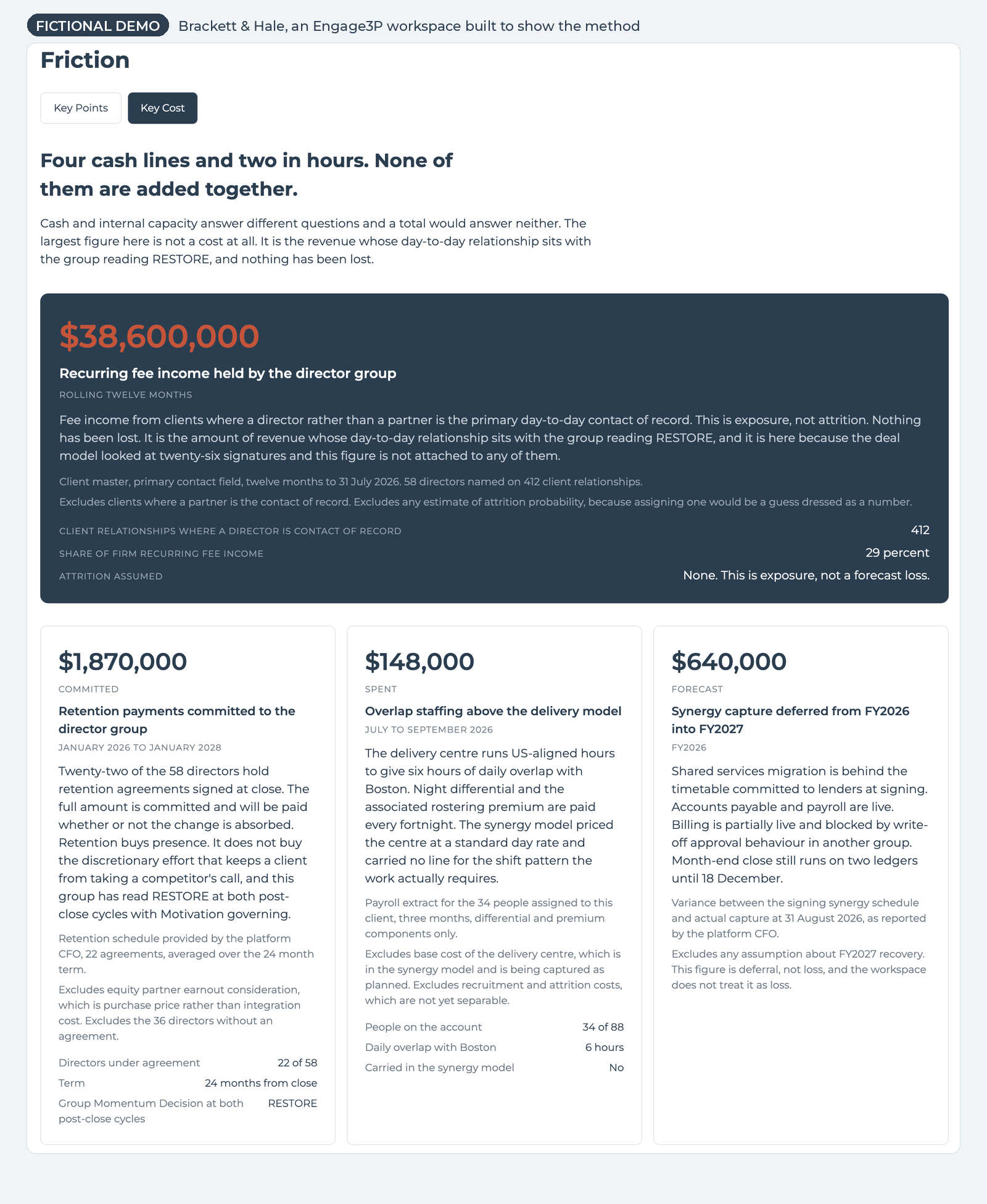
Those directors are the day-to-day contact on 412 client relationships, 29 percent of the firm’s recurring fee income. The deal model looked at 26 signatures, and that revenue was attached to none of them. Twenty-two directors received retention agreements worth $1.87 million. Thirty-six did not. Retention buys presence. It does not buy the effort that keeps a client from taking a competitor’s call.
The read found one more group nobody was watching. For eleven years, the operations team had informally carried the busy season surge work: chasing client documents, assembling files, keeping the season moving. None of it had a job title, so none of it was in the integration scope.
The read produced eight recommendations, each with an owner and a date, all due before signing. Among them: name the partnership path for directors in writing before close, document the surge work before the operations team moved, and publish a schedule of what stays in Boston and what moves.
What happened next, and what it proves
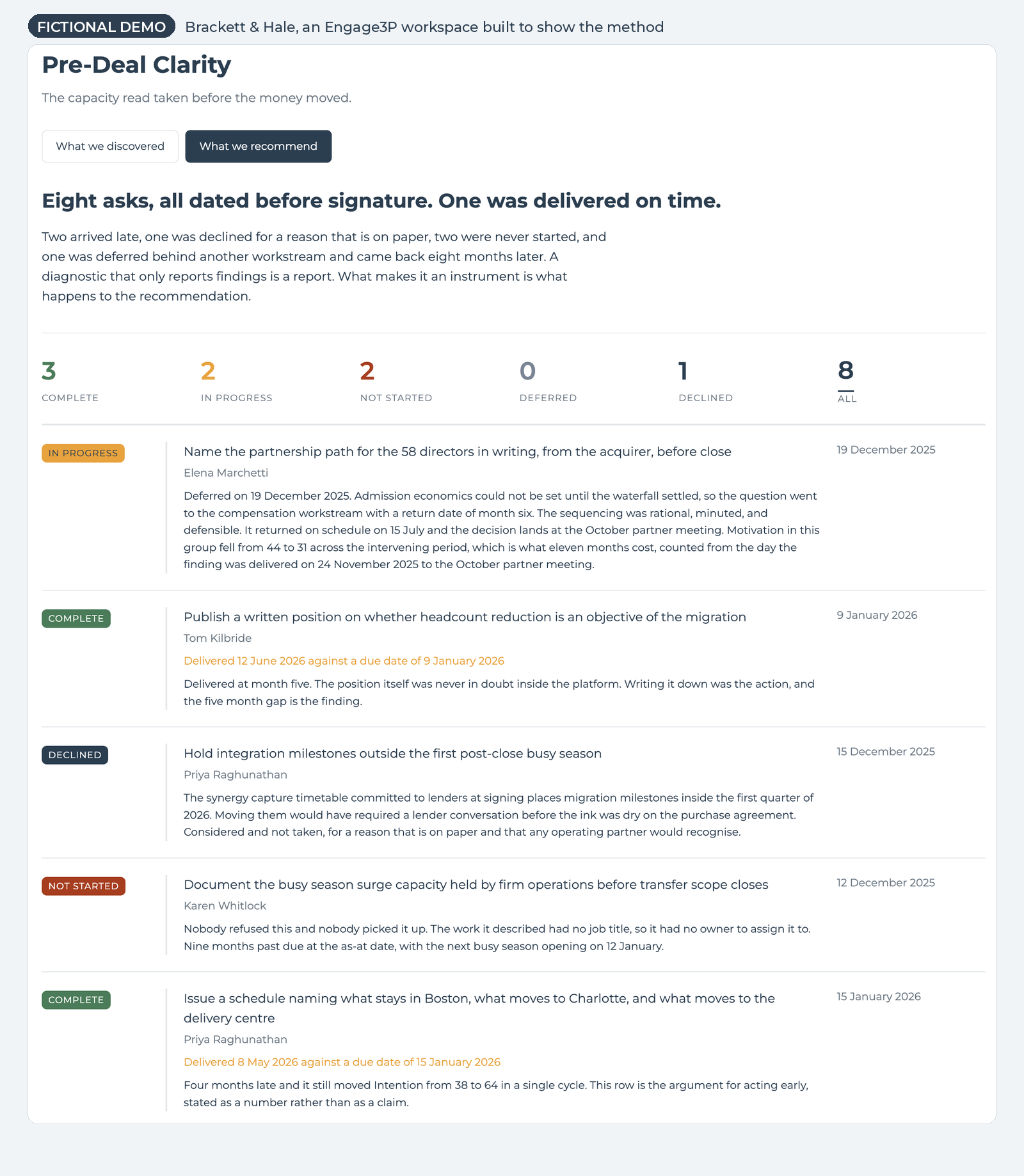
Where the deal team acted, people moved. Where it waited, the cost showed up.
The schedule of what stays and what moves arrived four months late. Even late, clarity in the operations group went from one of the weakest reads in the firm to one of the strongest in a single cycle.
The clearance for the offshore delivery centre to access client files was delivered on its due date. The group responsible for it is the only one that has stayed healthy at every read.
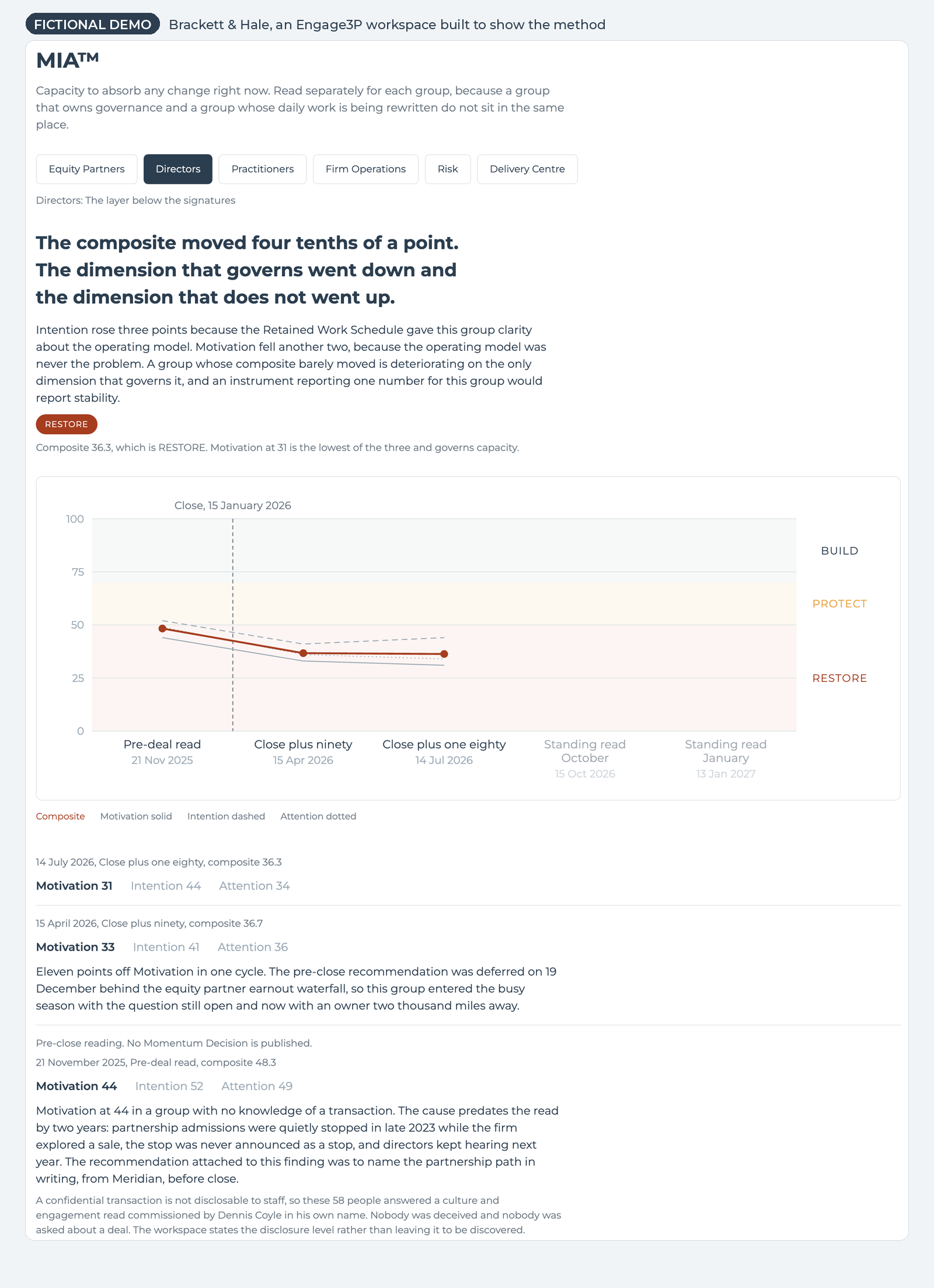
The partnership path was deferred behind the partner earnout, for reasons that were sound and minuted. Director motivation fell further at every read after close. Their overall score barely moved, so a single number would have reported stability.
The surge work was never documented. Nobody refused it. It simply had no owner. When busy season arrived, 4,640 hours of it landed on audit and tax staff, and their attention dropped sharply.
The delivery team was never briefed on escalation and review expectations. Directors now redo the offshore work on 31 of 40 sampled engagements instead of reviewing it. In a firm that bills by the hour, work done twice is an hour billed to nothing.
Didn’t the deal work anyway?
The revenue line invites that question. Fees are at plan and no client has been lost. But 232 days after close, not one line of the investment thesis can be called delivered. Part of the synergy capture has slipped into next year. The 26 partners have made two advisory introductions in eight months. And the audit base may be intact because the transition worked, or because 58 directors are holding it together with discretionary effort. Those two states look identical in the revenue line and completely different in the capacity data.
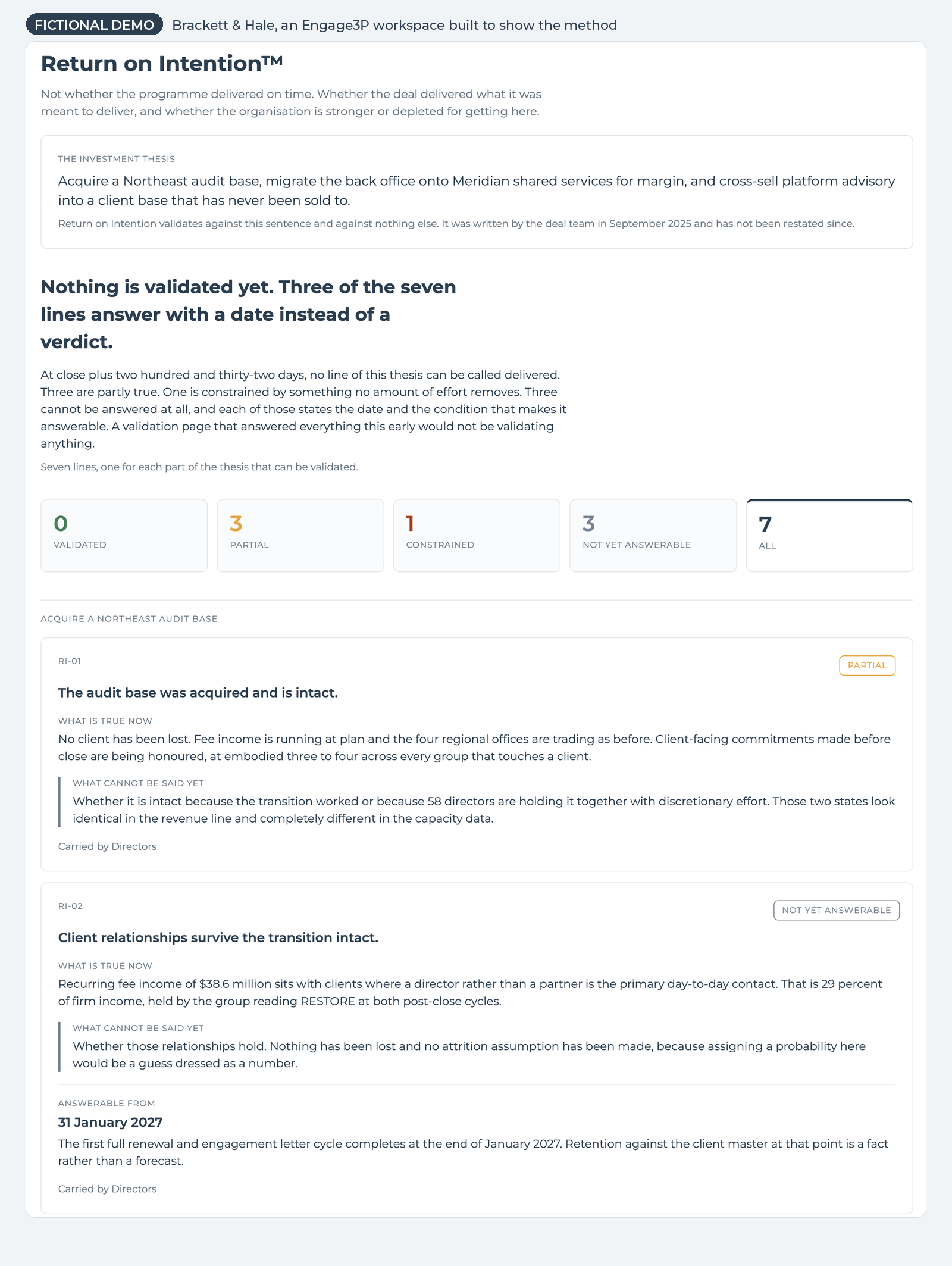
Human due diligence does not take credit for what the revenue line shows. It shows what the revenue line cannot: where the value is being carried, by whom, and at what cost, while there is still time to act. Return on Intention™ then validates the investment thesis line by line, and every line that cannot be answered yet carries the date it can be.
What human due diligence is not
It is not a culture survey, and it is not an engagement score. Both report averages, and averages hide exactly the group a deal depends on. It does not replace financial diligence either. It reads the part financial diligence was never built to read.
Questions deal teams ask
Can human due diligence run on a confidential deal? Yes. Signatories see the transaction named. Everyone else takes a read that never mentions it, and the disclosure level is recorded openly.
Who gets read? Every group the thesis depends on, not only the names on the retention schedule. The people holding client relationships and institutional knowledge are often a layer or two below the signatures.
How is it different from a culture assessment? A culture assessment describes the organization. Human due diligence reads each group against what the deal will ask of that group, and attaches a named owner and a date to every finding.
When is it too late? Never, but waiting costs more. In the example, every read that passed while the partnership decision waited showed director motivation lower, in the group holding 29 percent of recurring revenue.
Does your value creation plan have a people line?
Engage3P brings the human side into the deal, from the read before signing through integration to validating whether the thesis held. A 30-minute Clarity Call covers where the people line sits in your value creation plan. No pitch. No pressure.
Shera L. Haliczer is Founder and Chief Momentum Officer of Engage3P, with more than 20 years inside integrations, from the CHRO chair at NYC law and accounting firms to the tech side with 200+ global clients.
